
01 · The game
One deck, several ways to play
The full deck has 30 distinct faces: nine ranks in each of the Vạn, Văn, and Sách suits, plus Chi Chi, Lão, and Thang. Four copies of each make 120 cards. A Chắn is an identical pair; a Cạ pairs compatible but different faces.
Many published Chắn rules remove 20 cards and play with 100. Tổ Tôm keeps the full deck but assembles hands differently. Our table keeps all 120 while aiming for pair-based Chắn hands. Deck size and actual play both matter when comparing variants.
cards in our deck
players at the table
pairs in a winning hand
02 · Our story
What this table means to me
I grew up watching my grandparents, parents, aunts, and uncles play Bài Chắn. We still play on family vacations and occasionally at home. I started documenting what they taught us because the 120-card game I know is hard to find in online Chắn guides.
Four relatives answered a rules questionnaire. Their answers guide the online table and this page. Where memories differ, I mark the current software behavior as a working rule, not as a rule shared by every Chắn player.
03 · How to play
Our current table rules
This is the same ruleset taught in the game’s illustrated guide. It combines family answers and explicitly provisional choices. Vietnamese action names appear on the digital table.
1. Learn the cards and pairs
The numbered ranks are Nhất (1), Nhì (2), Tam (3), Tứ (4), Ngũ (5), Lục (6), Thất (7), Bát (8), and Cửu (9), each in Vạn, Văn, and Sách. Chi Chi, Lão, and Thang add three special faces. There are four copies of each face.
Chắn · identical pair
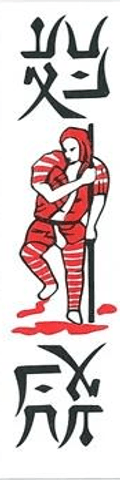
Two of the exact same face. Pairs in your concealed hand count; they need not be exposed.
Cạ · compatible pair
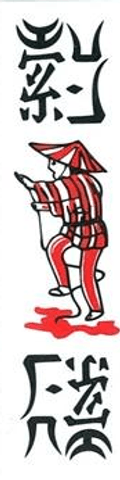
Same rank, different suits. A mixed Nhất/Yêu pair may also be a Cạ under our table rules. Tam Văn and Tứ Sách would not pair.
Six special faces
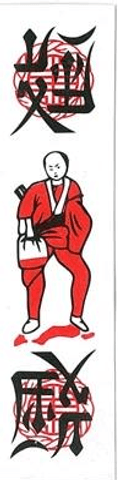
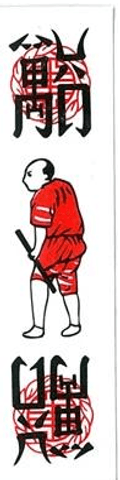
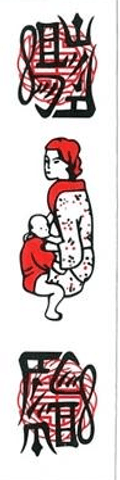
The three Nhất faces, Chi Chi, Lão, and Thang can form mixed Cạ with one another; identical copies remain Chắn. Lão + Thang is a provisional default. With an odd number of these cards, you may claim a Cạ using a spare card while preserving exact pairs. Mixed special Cạ may be in a winning hand, but cannot be the final pair completing Ù.
2. Deal and take a turn
Four players: the opener gets 24 cards; each other player gets 23. Five players: the opener gets 20; each other player gets 19. The opener discards without drawing, or declares Ù if the dealt hand already wins. Play moves clockwise; a winner opens the next hand.
- Bốc · draw from the wall
- Reveal the card at the public gate. It does not go straight into the drawing player’s concealed hand. Eligible players may react.
- Ăn · claim a pair
- Combine the offered card with one from your hand, expose the pair, then choose a card to Đánh (discard). You may claim Cạ before meeting the Chắn minimum.
- Chíu · claim the fourth copy
- When you hold three identical cards and the fourth appears, you may expose all four. It counts as two Chắn and is always a player choice. A nonwinning Chíu with a special card is allowed.
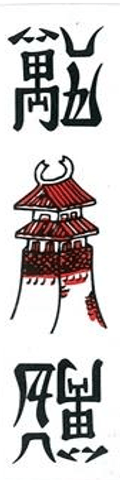
An out-of-turn Chíu returns a card to the interrupted gate. The interrupted player may claim it and discard again or pass that card onward; play does not jump to the Chíu player’s next seat.
3. Pass and discard carefully
- After declining a Chắn, you cannot later claim, Chíu, or discard that face, even if it appears from the wall.
- After declining a Cạ, you may still Chíu later. Our current default bans another Cạ claim of that exact face while allowing a later Chắn; the family is still discussing the full scope.
- Once you discard a face, you cannot later eat that face as Chắn or Cạ.
- After eating Cạ, you cannot discard both sides of a Cạ. You also cannot break an existing Cạ to eat a different Cạ from that group.
4. Win with Ù, or reach a draw
Pair the entire hand: 12 pairs with at least eight Chắn for four players, or 10 pairs with at least six Chắn for five. Concealed and exposed pairs count, and Chíu counts as two Chắn. No unmatched cards remain.
- Any eligible player may win on a public wall draw. Another player’s discard can complete a win only through Chíu-Ù.
- Chi Chi, Lão, or Thang cannot be the card that completes Ù, even through Chíu-Ù.
- Wins take priority over Chíu. Competing wins follow seat order from the active gate. Returned cards permit Chíu and Chíu-Ù; ordinary Ù on a returned card remains unresolved.
- Explicitly passing Ù forfeits later wins that hand. Discarding instead of taking an opening win has the same effect.
- The winner reveals the whole hand. If the wall runs out first, the hand is a draw; discards are not recycled.
Silence or disconnection does not trigger an automatic timeout. The deadline for reclaiming the same offered card is still being clarified.
04 · Research
History, names, and evidence
The 120-card pack is well documented; finding a published description of our exact 120-card pair game is harder. The notes below separate documented card history, player recollections, and our family’s own answers.
The cards and their history
The full pack has 30 faces, with four copies of each: ranks Nhất through Cửu in the Vạn, Văn, and Sách suits, plus Chi Chi, Thang Thang, and Ông Lão (Ông Cụ). That is 27 numbered faces and three special faces, or 120 cards. The common 100-card Chắn pack omits all three Nhất faces, Thang, and Lão, four copies of each. Pagat's card inventory documents the full pack; the game collection lists the 20 cards removed for ordinary Chắn.
The deck belongs to a wider family of East Asian money-suited cards, with Chinese-character rank and suit marks. Surviving decks were made by the Marseille firm A. Camoin & Cie for use in Vietnam; some familiar figures wear Japanese-style clothing. A collector documents examples from roughly the late nineteenth and early twentieth centuries. Another collection points to an earlier textual mention of a possible precursor, Tụ tam bài, in Phạm Đình Hổ's Nhật dụng thường đàm; I have not yet checked that original passage. The surviving cards show cultural influences and card manufacture, but do not establish that the game itself was invented in Japan or in France. Its exact origin remains an open historical question. See The World of Playing Cards and the game collection's historical note.
Does “Chắn” name the deck or our game?
In the rules, a chắn is a pair of identical cards; a cạ is a pair of the same number in different suits. Đánh chắn means “to play Chắn”; it is not a separate variant name. In everyday speech, bài chắn can mean the game or the cards used for it. Chắn is therefore a meaningful game name, but it does not by itself specify whether a family removes 20 cards. Calling ours “my family's 120-card Chắn” is the clearest description until we find a more established name for this exact ruleset.
A comment under a 2024 video about Tổ Tôm independently remembers a family Tết game called bài chắn with 120 cards. The writer recalls alternating red and blue decks and names Tôm, Lèo, Bạch Định, Thập Điều, and Bạch Thủ. Another commenter says there are several Chắn styles, including play with Yêu cards. These are promising leads, not proof that either table follows every one of my family's rules.
I checked two more Chắn lessons against that 120-card recollection. In a player's rules demonstration, the speaker twice says the deck has 100 cards. He describes four players, 19-card hands, a 20-card win, and at least six chắn. He later teaches Tôm and Lèo as scoring calls in that same 100-card game. I also read all 44 retrievable comments under a Chắn Sân Đình developer tutorial and all 37 under the player's lesson; neither thread identifies a 120-card Chắn game. This makes the earlier comment's explicit 120-card count the useful clue. Tôm and Lèo alone do not distinguish the deck.
A card-identification tutorial makes the conventional distinction especially clear: Tổ Tôm has 120 cards, while Chắn removes 20 and uses 100. The presenter later counts 25 Chắn faces with four copies each and says the Nhất rank is absent. A commenter likewise names Nhất, Thang, and Ông Cụ as additions for Tổ Tôm. I also checked a long online match and two short play recordings. Their visible three-player tables show a stock counter at 23 early in play, consistent with the 100-card tutorial's dealing method, but they do not explicitly inventory the deck. None provides a positive example of 120-card Chắn.
In another online match, the audio says Tôm as the game displays a winning score with one Tôm and one Ăn Bòn. An earlier result screen lists Tám Đỏ and Chíu; opening rounds show a stock counter at 23. The clip and its 11 retrievable comments offer no explicit 120-card claim. It confirms why scoring words must be read alongside the card count and table rules.
Open questions
Our family still needs concrete examples for a few special Cạ, claim priority, return-card wins, the last wall card, and scoring. I will revise the rules as we test them together, with dated examples of complete hands.
Research method and sources
How to read this project
I keep three types of evidence separate: published descriptions of the cards and ordinary Chắn, four relatives' questionnaire answers about our table, and outside player recollections such as the video comment. On September 22, 2026, I reviewed 492 retrievable comments and replies under the Tổ Tôm video. I kept 38 explicit Chắn references and direct replies to the 120-card recollection after excluding comments discussing Tổ Tôm as a game. I then reviewed 81 retrievable comments and replies across the Sân Đình and NDT lessons, 39 across the next four videos, and 11 under the synchronized online match; the two short recordings returned no comments. Transcripts and auto captions may mishear Vietnamese terms, so I rely most on repeated card counts, hand sizes, and visible rules. An online comment may suggest another house variant; it cannot establish a game's origin or settle a disputed family rule. My aim is to publish the complete 120-card inventory, reproducible deal and win examples, and a ruleset that family members have actually checked.
Primary family source: private four-person rules questionnaire, reviewed September 2026. External references: Pagat, Sekai Yūgi, The World of Playing Cards, the Tổ Tôm video comments, the Sân Đình tutorial, the NDT rules lesson, and the An Brothers card tutorial.
06 · The code
Help build the online table
The public Bài Chắn repository contains the web game, rules engine, and contribution guide. It supports practice with bots and private four- or five-seat rooms. Code and documentation use the MIT license; card art and audio have separate rights.